
Ripples of the Iran Energy Crisis

The ripples of the Iran energy crisis
Rising fuel prices are threatening growth and stoking inflation, as supply shortages, strained refineries and opaque markets create fresh risks for the global economy.
By Malcolm Moore and Sam Fleming
Just as the global economy seemed to be shaking off its fever from this year’s energy crisis, the temperature is rising again and the prognosis is worsening. The price of crude oil has pushed past $100 this month and inflationary pressures are mounting in the US, the EU and the UK. Fuel price protests have broken out from Syria to Guatemala, while India and the Philippines have introduced emergency energy-saving measures.
The summer was characterised by what many see in retrospect as a false sense of security. In June the US and Iran signed a deal to extend their fragile truce and reopen the Strait of Hormuz, the world’s main oil chokepoint, allowing over 130 tankers to escape the Gulf and deliver their cargoes to the world.
The deal soon collapsed, and there now seems little prospect of a speedy end to the conflict, even as the Russia-Ukraine war puts further pressure on energy prices. Many experts warn that the oil and gas market may be dangerously tight in the autumn and winter, with serious consequences for inflation and growth. Joe Brusuelas, chief economist at accounting firm RSM US, warns the world has entered “oil shock 2.0”. He adds that central banks will need to “slow down the global economy if they want to push the inflation genie back into the bottle”.
But the energy price shock is not what many people think it is. Here are five ways in which it is wrongfooting the world.
Economists were too pessimistic. Nowthey face the opposite problem
To date, global growth has defied many economists’ forecasts, partly because the oil and gas trade turned out to be unexpectedly resilient after the US and Israel attacked Iran on February 28.
Fatih Birol, the head of the International Energy Agency, warned in March that the world was facing “the greatest global energy security threat in history”, referring to the scale of oil and gas cut off from global markets. But although countries began preparing for shortages of key fuels, prices never broke through previous records because of a co-ordinated release of 400mn barrels of strategic reserves, the withdrawal of China from buying crude and the robustness of the global trading system.
The world economy grew at the same annualised pace in the second quarter of the year as in the first, according to calculations by Capital Economics, a research firm. Those numbers omit the six Gulf Cooperation Council nations, which include Saudi Arabia, the world’s top oil exporter, the United Arab Emirates, and Qatar, the second-largest producer of liquefied natural gas.
Isabelle Mateos y Lago, group chief economist at BNP Paribas, sees such economic resilience as the result of a “tug of war” between the AI boom, which has stoked growth, and the energy crisis. She thinks the trend can continue, noting the scale of capital expenditures on data centres and AI.
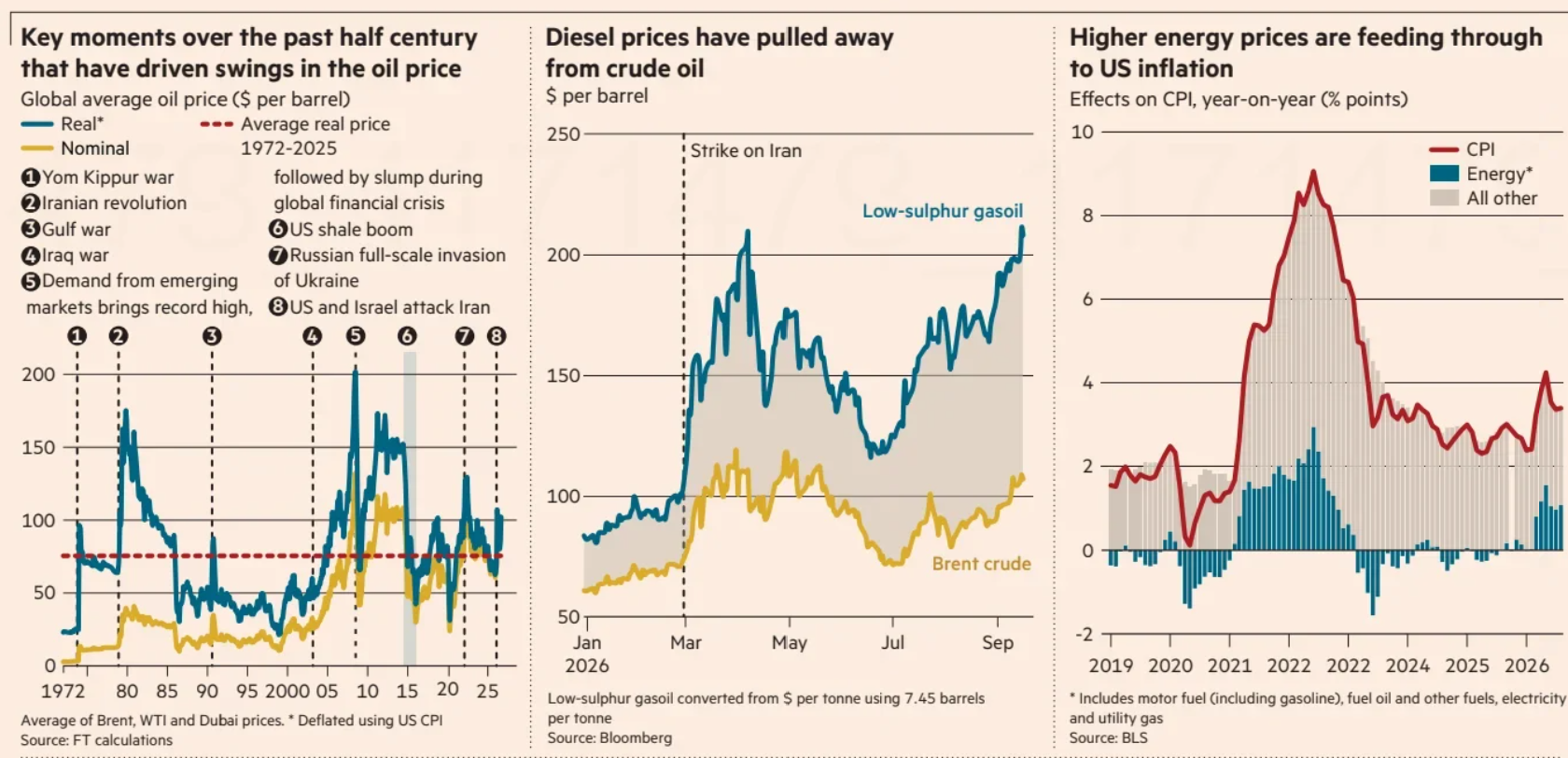
But the price pressures are making themselves felt. On Wednesday, the US Federal Reserve raised interest rates for the first time since 2023; it is far from the only central bank applying the brakes in response to the inflationary pressures caused by the war.
Last week the European Central Bank warned of “risks to the upside” for inflation and to the “downside” for economic growth, as it increased rates for the second time since the seven-month-old war began. On Friday, the Bank of Japan took its rate to a 31-year-high. Neil Shearing at Capital Economics warns that if crude oil prices hover between $110 and $120 a barrel for the next six months, global growth would fall towards 2 per cent — much less than last year’s rate of 3.5 per cent. “It would start to feel pretty recessionary,” he says.
Fears of slower growth as central banks increase borrowing costs are also feeding back into the oil market, potentially putting a ceiling on crude prices.
This is a fuel crisis, not an oil crisis
The price of crude oil has traditionally been the warning signal for the global economy. But consumers do not buy crude oil, they buy petrol, diesel and jet fuel, and it is the price of these fuels that ultimately feeds through into inflation.
Over the course of the Iran war, fuel markets have been far tighter than crude markets because of a shortage of capacity to refine oil into fuel and the high cost of shipping.
As early as June, even as crude oil prices were coming down, Tom Baker, the head of oil trader Vitol in the Middle East, was warning about a gloomy outlook for refined fuels for the rest of this year. That month, China’s independent refineries cut production to a nine-year low after a government ban on exports left them unable to sell fuel overseas.
In Russia, the world’s third-largest refiner after the US and China, a sustained campaign of drone attacks by Ukraine has reduced production by 30 per cent in the past year to its lowest level in over ttwo decades.
By August, exports of diesel from the huge refineries in the Middle East had fallen to a quarter of their prewar level according to the IEA, which has been coordinating the response to the crisis.
The world’s refineries have been running at full speed. But they have been unable to catch up with the losses. Global output of refined fuels was over 4mn barrels a day lower in August than a year earlier, according to the IEA.
This month, the price of diesel in the US and Europe passed $200 a barrel and US diesel prices passed $6 a gallon for the first time ever, almost double their prewar level. Diesel, which is essential for trucking, as well as for heating in the winter, accounts for almost a third of global oil demand.
Things could get worse. China, which allowed its refineries to start exporting fuel again over the summer, is thought to be considering a fresh ban after seeing its domestic fuel stocks fall. If Beijing halts exports a second time, fuel prices will be under severe pressure.
This is not an old-fashioned oil shock
Even at $110 a barrel, oil is not as expensive as it used to be. The record price for a barrel of Brent crude was $147.50 in 2008, the equivalent of $230 a barrel today when adjusted for inflation. Oil averaged more than $110 a barrel in 2011 and 2012, or $165 in today’s money.
Nor has the price rise been as steep as in the past: between 1973 and 1974, after Arab producers imposed an embargo in response to western support for Israel in the Yom Kippur war, prices quadrupled to $12 a barrel (worth $82 today).
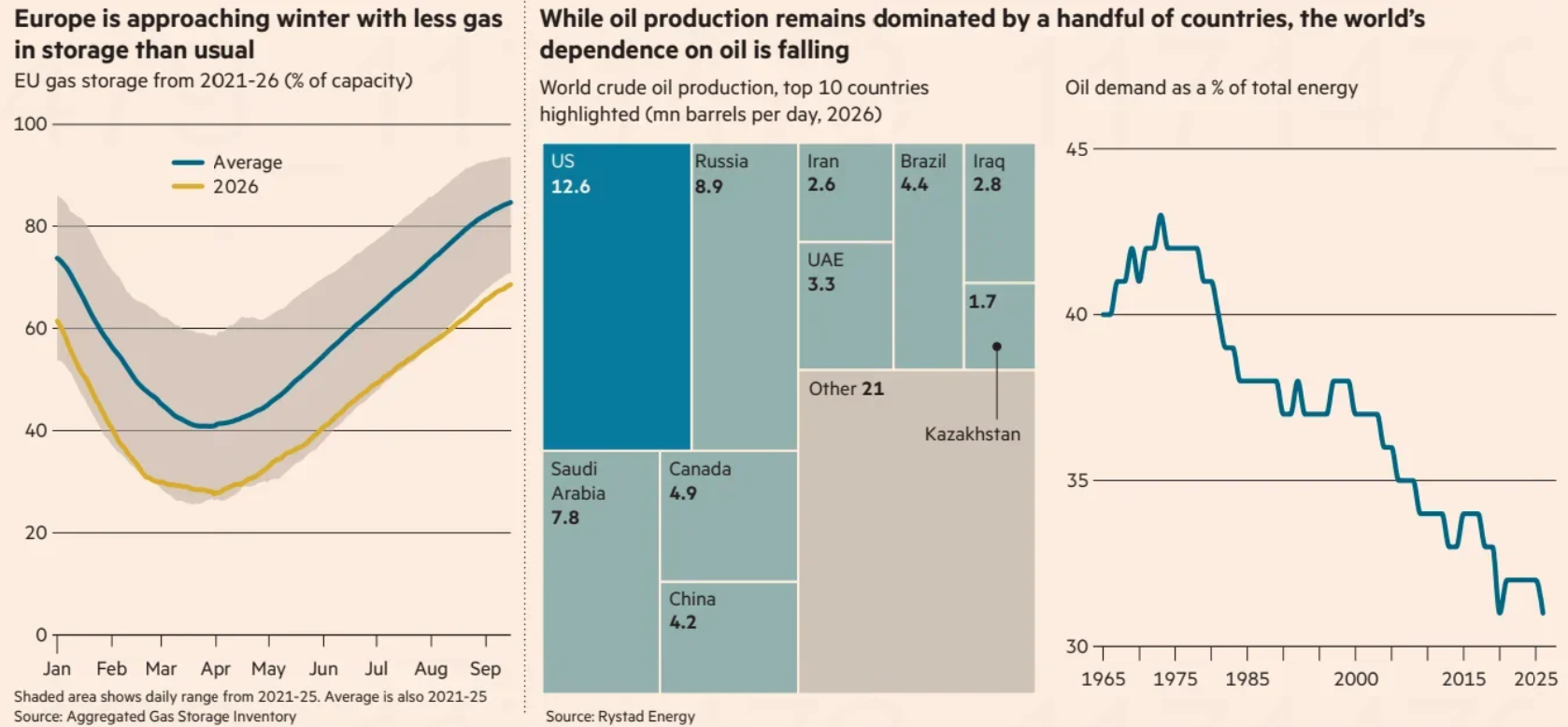
Oil production is also less concentrated in the Middle East. The US is now the world’s largest producer, ensuring it will not have a supply shortage. More importantly, a barrel of oil matters less to the global economy than it used to.
Oil’s share of global energy demand has fallen below 30 per cent from a peak of 46 per cent half a century ago. When the Iran war began, by contrast with the 1970s energy shock, the world had strategic reserves, an oil glut and growing supplies of liquefied natural gas.
Still, higher hydrocarbon prices have already led to changes in behaviour, such as a faster pace of electric vehicle sales in Europe and Asia. Over the past seven months, Chinese petrochemical plants have cut production, airlines have trimmed marginal routes and Asian countries have switched from gas to other fuels, including coal.
Gas prices have also risen 160 per cent since the war started and have been rising further in recent weeks. The continent is approaching winter without its usual backup stores.
Poor countries get hit the hardest
Protests broke out in Syria this week after the government raised diesel prices by 40 per cent and petrol by nearly 30 per cent, due to what it called “an exceptional increase in the global cost of procurement”.
Bangladesh and Pakistan have both struggled to import gas. Restaurants across India were forced to close because they had run out of liquefied petroleum gas. The Philippines declared a national emergency and mandated working from home.
By far the most common response to the crisis, according to the IEA, has been to shield consumers, with 94 countries cutting taxes, capping prices or subsidising fuel. So far, most countries have avoided unrest but at vast expense.
The west has been relatively untroubled — so far. But while the price of petrol in the US remains far below Europe and elsewhere — due to lower taxes — the $5 a gallon now charged in some states is around the national peak reached in the Biden administration. It is not the economic backdrop President Donald Trump wanted for the US midterm elections on November 3.
The oil industry is also in the dark
Oil and gas executives have warned about the looming crisis but have so far resisted making predictions about what it means for energy prices.
In part, that is because they do not know, one energy executive privately acknowledges. Many companies in the sector expected prices to soar after onefifth of the world’s oil and gas supplies were cut off. Instead, traders have regularly sold down their positions during the seven-month war, often reacting to claims from the White House that a peace deal was imminent.
The US publishes weekly data on its oil stocks. But many countries only release such information monthly, and China, the world’s largest importer of oil, does not release regular figures at all.
The market has swung wildly because it has been flying blind, with no accurate and timely data on how much oil the world has in reserve, or on consumer demand. “Those are the two most important things to know and we do not know either of them,” says the executive.