
Government Debt

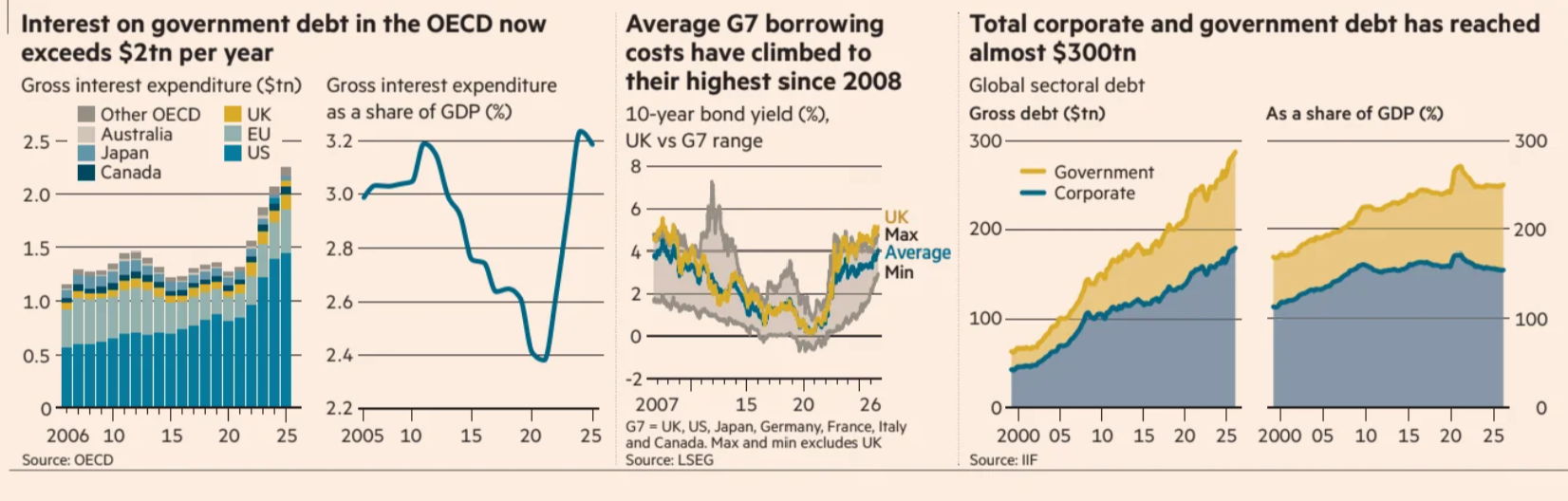
The world’s $2tn interest bill
Mounting borrowing costs and record debt are squeezing public finances, forcing governments to choose between higher taxes, spending cuts and vital priorities such as defence.
By Ian Smith, Sam Fleming and Emily Herbert Data visualisation by Jonathan Vincent
The world’s governments have created a $2tn monster — a debt-servicing burden that gobbles up tax revenues and has the power to overwhelm elected leaders.
More money is now spent on servicing the national debt than on defence in the UK, France and the US; the same is true for more than a dozen states in the 38member OECD rich countries’ club.
Their problem is that borrowing costs have climbed to the highest in almost two decades just as governments are taking on record debt.
The total owed by the US government reached a record $40tn last month. This year, OECD nations are expected to borrow $18tn between them, another all-time high. In 2025, the group’s total debt-servicing bill exceeded $2tn, or 3 per cent of GDP.
That number is set to rise in the coming years because of the bond sell-off that has pushed up yields since the Covid-19 crisis, increasing the cost of debt for governments across the world.
“These massive sovereign debts are having to get refinanced at ever-increasing rates,” says Mike Riddell, a fund manager at Fidelity International. “Global investors are already starting to get scared.”
The summer rout in the global bond market has only augmented the postCovid surge in yields triggered by inflation shocks, increased government borrowing and the end of central banks’ “quantitative easing” bond-buying programmes. The average benchmark 10year bond yield for G7 countries has reached 4 per cent for the first time since 2008, amid concerns about the inflationary impact of the Iran war and the sheer amount of debt being sought by both the public and private sectors — particularly tech groups.
Some economists counter that US yields in particular are being pushed up by improving growth expectations, which imply that interest rates will not need to be as low in the future to support the economy. If there were a step change in growth, it could be a get-out-of-jailfree card for many countries, boosting tax receipts, making the stock of debt more manageable and reducing the trade-off between interest costs and other areas of spending.
But at present the panorama looks very different. For big indebted economies with low growth such as the UK and France, debt servicing has already forced a reckoning in the management of the public finances. For Britain, a sharp rise in bond yields helped eject former prime minister Liz Truss from power in 2022 after an unfunded taxcutting “mini” Budget. But yields are higher still now: the UK’s interest payments are currently £110bn a year. In turn, France has churned through three prime ministers since parliamentary elections in 2024, partly because of fiscal pressures set off by the cost of debt.
In both countries and in many others across the world, politicians face a fundamental choice on whether to raise taxes or shrink the state to get themselves out of the corner they find themselves in. The sheer scale of debt-servicing costs also makes it supremely difficult for countries to raise spending for strategic priorities such as national defence and energy security.
“If debt interest were a government department, it would be the second biggest in Whitehall after health, bigger than defence, the Home Office and justice put together,” John Healey, Britain’s new chancellor of the exchequer, said yesterday. “There’s nothing progressive about the government spending £1 in every 10 [pounds] on debt interest.”
Why yields are going up
Up until the 2008 global financial crisis, interest rates were relatively high for major economies, but levels of debt were generally much lower. After that, debt surged but interest rates were kept lower by emergency measures taken by central banks as well as low economic growth. Now, by contrast, policymakers face an unenviable combination: record debt and high borrowing costs.
While governments are still finding enough buyers for their debt, investors are demanding a higher price for their money. New bond sales in recent months for the UK, the US and others have locked in the highest yields in almost two decades for longer-dated debt. This shift has been accelerated by changes to pension schemes in some countries that have meant traditional long-term buyers stepping back, replaced by fast-money hedge funds that can be quick to demand higher yields.
“The era of free money is definitely over,” says Kim Crawford, a global fixed income manager at JPMorgan Asset Management. “The bond market is [now] looking for discipline.”
The nature of government debt markets, in which governments fund themselves with debt that is repaid at a wide range of durations, some coming due decades into the future, means that the transmission of higher borrowing costs into higher interest costs occurs gradually over time.
But the direction of travel seems clear. The US’s Congressional Budget Office estimates that America’s debt costs will double over the next decade and, on the current trajectory, exceed Social Security spending after 2047. The burden for other countries — which typically find it harder than the US to convince investors to buy their bonds on favourable terms — is likely to be higher still.
The causes of the problems with public finances are deep-rooted and longrunning. They include a surge in spending to battle the Covid-induced slump and energy crises, as well as broader fiscal challenges since the financial crisis brought down rates of growth.
Global public debt hit 94 per cent of world GDP last year, up more than 10 percentage points since the year before the pandemic. The IMF now believes it will reach 100 per cent by the end of this decade. This summer’s bond sell-off has aggravated the problem. Inflationary pressures stoked by the Iran war, initially in energy prices, have forced central banks to pivot towards rate increases. The European Central Bank raised rates in June for the first time since 2023, and is expected to do so again this week, while Federal Reserve chair Kevin Warsh has begun to tee up an increase as soon as this month.
Some investors argue the uncertainty over inflation is feeding into higher long-term rates, with the market demanding more to lend to a government over the long term. Others think that the higher yields are more a reflection of worries over growing debt supply, both from governments but increasingly from the corporate sector.
The stock of combined government and corporate debt globally is approaching $300tn, according to the Institute of International Finance, a think-tank.
Concerns about the limits of markets’ willingness to finance such a spectacular amount of debt come on top of investors’ worries about developed governments’ unwillingness to rein in borrowing. The US fiscal deficit, for example, is projected to remain above 7 per cent of GDP into the 2030s, according to the IMF, despite the country’s relatively steady growth and an unemployment rate of just 4.1 per cent today.
Political volatility has already led to higher debt interest costs than would have been paid otherwise, some investors argue, in what is sometimes dubbed the “moron premium”. In Europe, political fragility since 2022 has added €100bn to interest expenses for the UK, Italy, France, Spain and Belgium, estimates insurer Allianz. Part of the rise in yields this year could be investors demanding compensation for political ructions to come.
Another factor unsettling the bond market this year has been events in Japan, for a long time the anchor that helped to hold down global borrowing costs due to its negative interest rate regime and voracious demand for foreign assets. Now, the country’s central bank is increasing interest rates just as Prime Minister Sanae Takaichi embraces stimulatory government spending. As Tokyo’s borrowing costs climb to levels not seen since the 1990s, investors are fretting that the higher yields at home will attract money back from other markets, pushing up costs elsewhere.
Doomed to a doom loop?
One big worry for investors is that some countries may be edging towards a vicious cycle in which rising debt costs make the fiscal outlook still worse.
In this “doom loop” scenario, the sheer scale of interest charges a government has to pay undermines the health of its finances and pushes up its debt, causing investors to push for higher yields that then drive up the cost of debt servicing still further.
Unless lower interest rates or a surge of growth rescue government finances, the only alternatives are to increase tax revenue or cut spending. But markets are increasingly concerned that in many instances difficult cuts are politically unachievable, whether it is a question of reining in welfare expenditure in the UK or trimming overall government spending in the US. Indeed, President Donald Trump wants to increase the US defence budget to $1.5tn, the biggest rise since the second world war.
Politicians “don’t want to make these hard choices because they know if they do make these hard choices they are going to get kicked out at the next election”, says Neil Mehta, a portfolio manager at RBC BlueBay Asset Management. “I don’t know how this resolves itself.”
The anxiety surrounding US indebtedness is bleeding into global markets and infecting any other sovereign borrowers seen as particularly fragile — among them other “serial offenders” such as Britain, Italy and France, says David Rees, head of economics at asset manager Schroders. Some investors have this year dubbed the trio the “Bifs”, for their high debt loads and vulnerability to the energy shock.
While the dollar’s status as the world’s premier reserve asset means many investors have little option but to buy Treasuries, other countries’ finance ministers may well have to do more than the US to get their fiscal houses in order.
“No one is expecting miracles” in terms of deficit reduction, says Gilles Moëc, chief economist at insurance company Axa. But countries need to show they can get or keep the headline deficit on a declining path even if the US is unlikely to do so.
A key test in the UK will come next month with the first Budget since Andy Burnham became prime minister in July.
Higher debt costs, including from the UK’s large stock of inflation-linked bonds, are eating up resources at a time when the government faces pressure to improve public services and fund pledges to lift defence spending.
That has triggered speculation that another round of tax increases will be required on top of big revenue-raising Budgets in 2024 and 2025.
Bullish investors say Britain, unlike some other countries, has taken hard choices. Gross debt issuance is actually down this fiscal year. But the UK’s borrowing costs are the highest in the G7 and the country’s spending on debt interest is expected to reach nearly 4 per cent of GDP by 2030-31, roughly double its share in the years running up to the pandemic.
France is facing similar pressure in funding markets, driving the spread between its 10-year borrowing costs and those of Germany’s ultra-safe debt — a key barometer of concern over Paris’s finances — to about 0.9 percentage points, close to its highest level since the aftermath of the Eurozone debt crisis.
Some Wall Street banks have downgraded their estimates for Paris’s public finances. Morgan Stanley now thinks the country’s fiscal deficit could hit 5.4 per cent of GDP this year, well above the government’s 5 per cent target.
Decisive action to rein in borrowing remains difficult at a time of pedestrian growth and the challenge from the far-right Rassemblement National in the April 2027 presidential election.
Today’s politicians are being forced to make “direct trade-offs between vitally important areas of spending and the debt interest bill”, says Carmine Di Noia, director for financial and enterprise affairs at the OECD. “Your interest bill is directly constraining fiscal policy.”
Breaking free
How do countries escape from their debt cage? One option is so-called financial repression, measures that compel domestic institutions to buy more of their country’s debt to support demand and push down yields. A happier outcome would be meaningful productivity growth, driven by the AI revolution, that would in turn make governments’ debt burdens much more manageable.
In the UK, the Office for Budget Responsibility, Britain’s fiscal watchdog, said recently that in a “high-productivity scenario” for the country’s economy, the debt burden as a proportion of GDP in 2075 would be just over half the baseline forecast, albeit still a daunting 180 per cent.
Some are sceptical the growth cavalry will rescue the rich world en masse from its budget dilemmas. For what he calls “basket cases” like the UK and France, RBC BlueBay’s Mehta says “the problems with growth are more structural . . . You do have to cut spending.”
History suggests governments will eventually do so. In a 2013 paper examining the experience of 55 countries for up to two centuries, IMF economists observed that “increases in the cost of sovereign borrowing prompt policymakers to tighten fiscal policy in response”. The UK has come back from bigger burdens. Its debt pile reached a record high of about 250 per cent of GDP after the ravages of the second world war, but spending restraint and economic growth helped by immigration sent it tumbling.
Another possible course was taken by Canada in the 1990s, when the government responded to a gaping deficit with painful spending cuts. “If you prepare them well, people will understand,” Paul Martin, the finance minister at the time, later told the FT. “They will not stay with you unless they feel that the sacrifice you’re asking of them is going to succeed.”
In the UK, some investors view tax rises as a better way to close the revenue gap, if the government can avoid measures that fuel inflation. But in many countries, it will be politically costly in the extreme to cut spending further, or pile more taxes on households and businesses struggling with the cost of living. “The problem is that markets don’t see a political will to make it work and to rein [debt] in,” says Tatjana Greil-Castro, global head of investments at Muzinich. “If you don’t rein it in, it will get worse and worse. [Then] it will have to end in a crisis.”